
A claim may be deferred by counsel or by the Trust. You may choose to defer a claim if additional time is needed to obtain documents or information required for the claim submission. Some trusts will automatically defer a claim when the deadline for responding to a deficiency has passed. A deferred claim retains its FIFO number, but it must be re-opened before it will receive further review.
In most Verus trusts, a claim may be deferred for a period of up to three years (the exceptions are ASARCO will only allow claims to be deferred for up to two years, ABB Lummus does not allow for deferral and Garlock only allows 1 year of Deferral time and this must be within the first year of filing; please see individual TDP's for specific information). Deferral time is cumulative; a claim may be deferred for an extended stretch of time or for shorter intervals, but all of this time counts toward the total deferral limit. The amount of time remaining before the limit is reached will be indicated in your Deadline Notifications, which can be downloaded on our website:
In most Verus trusts, a claim may be deferred for a period of up to three years (the exceptions are ASARCO will only allow claims to be deferred for up to two years, ABB Lummus does not allow for deferral and Garlock only allows 1 year of Deferral time and this must be within the first year of filing; please see individual TDP's for specific information). Deferral time is cumulative; a claim may be deferred for an extended stretch of time or for shorter intervals, but all of this time counts toward the total deferral limit. The amount of time remaining before the limit is reached will be indicated in your Deadline Notifications, which can be downloaded on our website:
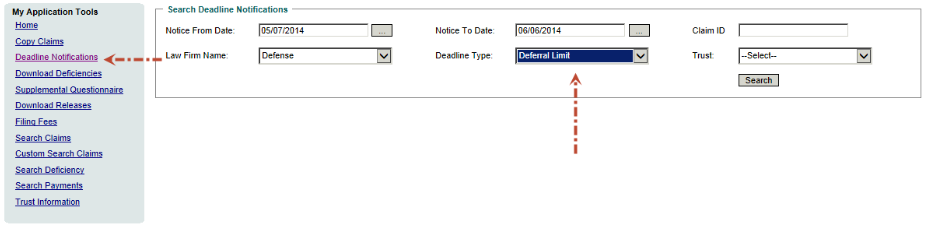
Please note that this search will give you the number of days that were remaining on the Report Date (not the current date) as well as the current status at the time you run the search. While a claim is deferred it will not be included in Deficiency Notifications. Any deficiencies in the claim that were not reported prior to the claim being deferred will be included in the next Deficiency Notification that occurs after the claim is reopened.
If the deadline for responding to a deficiency expires while the claim is deferred, this deficiency must be responded to on the same day that it is re-opened in order to avoid the claim being re-deferred (in trusts that defer claims when the deadline is passed) or withdrawn (in most trusts). Deferring a claim does not alter the deadline for responding to a deficiency, but the action associated with the deadline (re-deferral or withdrawal) will only take effect when the claim is reopened.
If the deadline for responding to a deficiency expires while the claim is deferred, this deficiency must be responded to on the same day that it is re-opened in order to avoid the claim being re-deferred (in trusts that defer claims when the deadline is passed) or withdrawn (in most trusts). Deferring a claim does not alter the deadline for responding to a deficiency, but the action associated with the deadline (re-deferral or withdrawal) will only take effect when the claim is reopened.